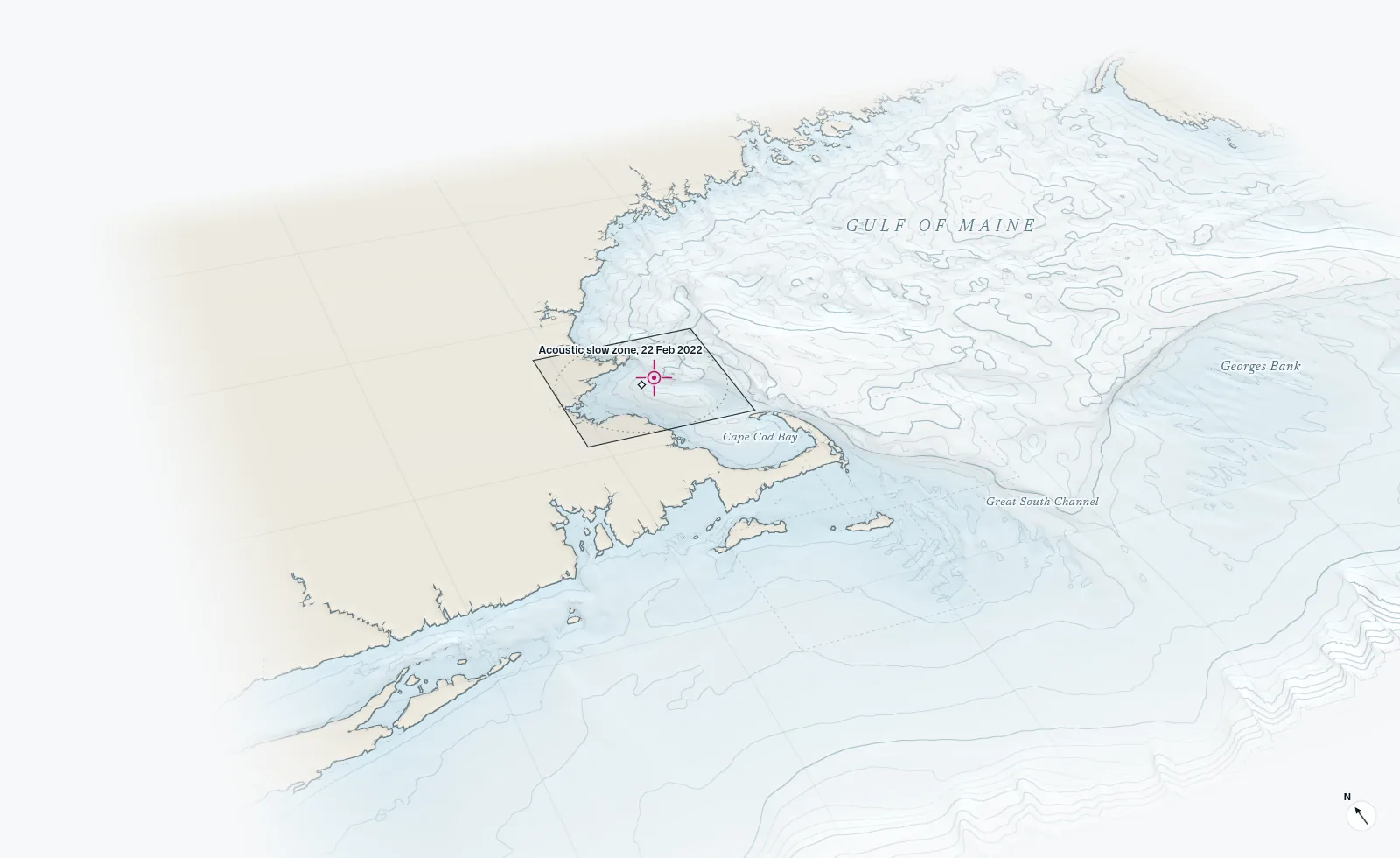
Glider, 22 February 2022
A glider east of Boston records right-whale calls.
The detection is relayed to shore. A single hydrophone can tell that a whale called within earshot. It can’t tell which direction the call came from, or how far it traveled.
It starts with the North Atlantic right whale. Today a slow zone is centered on whichever recorder heard the call. Sona uses a network of low-cost acoustic nodes to find the whale’s position, and centers the zone there.
Chapter 01
How one detection in February 2022 became a slow zone.
Glider, 22 February 2022
The detection is relayed to shore. A single hydrophone can tell that a whale called within earshot. It can’t tell which direction the call came from, or how far it traveled.
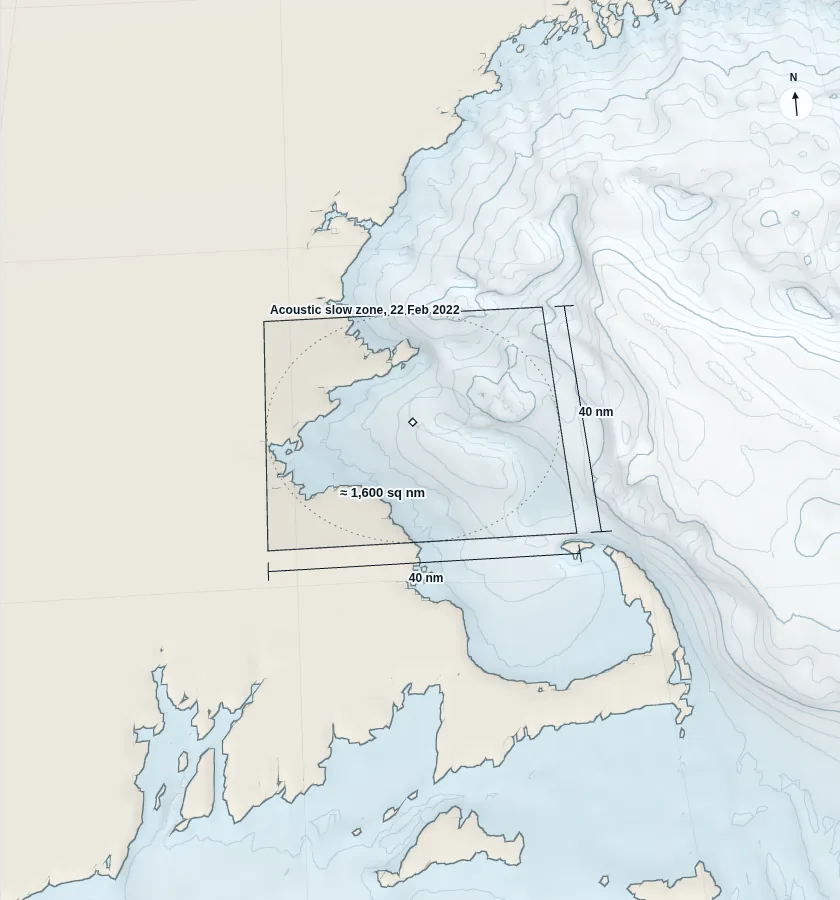
NOAA slow zone
1,600square nautical miles
With no position to go on, the zone is a box about 40 nautical miles on a side around the glider. For the next 15 days, mariners are asked to avoid it or slow to 10 knots. Compliance is voluntary.
Acoustic slow zones, 2022
47 of 77were triggered by acoustic detections
Three of them fell in this part of the Gulf of Maine: east of Boston in February, east of Chatham in March and southwest of Nantucket in November. Each was centered on a single recorder.
Chapter 02
From detecting a call to knowing where the whale is.
Single hydrophone
0.90recall at five false alarms per hour
A 2025 study ran a compressed neural network on an ESP32 and tested it in noise it had never seen. A detection on its own still leaves the whale anywhere within earshot.
Bearing from an array
6–8×as many unnecessary shutdowns without bearing
At offshore wind sites, a call that can’t be placed outside the exclusion zone stops pile driving. A study for the US Department of Energy compared buoys with and without bearing.
Position from three receivers
$50K–$1M+per node per year, from a NOAA survey of operators
That gives a position. Doing it in real time takes receivers that work as one network, and that is expensive today. The network behind US slow zones is eleven moored buoys, plus gliders, for the whole East Coast.
Chapter 03
Software that turns detections from a network of low-cost nodes into positions.
Zone centered on the whale
Every detection comes back as a position with its uncertainty, and the slow zone is centered on that position instead of on a recorder.
Zone sent to ships
83%of vessels slowed after an AIS alert in a NOAA pilot
Mariners have asked to receive zones as shapes on their chart plotters or over AIS. Sona sends them there and records how long each alert took from the first call.
Positions in the three 2022 zones
Because each node costs little, a network can reach the places where right whales feed and migrate. Every zone it triggers starts from a position.
Other whales and ships
It can locate other whales and passing ships, once the detector is trained on their sounds. Right whales come first because that is where the rules, the deadline and the public data are.
Chapter 04
NOAA is considering replacing seasonal speed limits with measures triggered in real time.
The speed rule takes effect. Vessels 65 feet and longer must slow to 10 knots in seasonal management areas from Massachusetts to Florida.Federal Register
NOAA proposes amending the rule.
NOAA withdraws the 2022 proposal.Federal Register
MITRE’s review for NOAA rates real-time acoustic monitoring as ready for detection and regional slow zones, and as early-stage for helping an individual vessel avoid a whale.MITRE
NOAA reports that 83 percent of vessels in its AIS alert pilot slowed after receiving a message.NOAA
NOAA opens a rulemaking on replacing seasonal limits with technology that can trigger slow-zone notices automatically and in real time.Federal Register
The Marine Mammal Commission writes that it is premature to treat these technologies as a replacement for the rule.MMC
NOAA’s proposed rule.
Investors with an account can sign in to the portal. To ask for access, email investors@sona.flow7.org.